Monday, January 14, 2013

Have You Filled a Bucket Today?

Before winter break, we read a story called "Have You Filled a Bucket Today?"  It is a fabulous book about how each one of us carries around an invisible bucket.  In this bucket is where we keep all our good feelings about ourselves.  With our words and our actions, we can either fill each others buckets or dip each other's buckets.
After we read the story, we made our own paper buckets for our classroom.

These are no ordinary buckets!  We learned that sometimes it feels like we might be able to fill our own bucket by dipping into someone else's, but we always end up feeling like our bucket is empty after we dip someone else's.  The good news, though, is that when we fill someone else's bucket, we also fill our own!  Try it sometime.  Invite someone to join your group, do something nice for someone, or tell someone you love them.  I bet your bucket will be feeling full before you know it!

We wrote letters to each other to fill our classmate's buckets (and our own)!  
Our buckets are over-flowing!  Have you filled a bucket today?


Reading for Understanding

Learning how to read is tough!  But learning how to read for understanding is even harder.  In the early grades, teachers and students (and parents) work hard on phonics.  We talk about how letters make sounds that blend together to make words, teach kids how to decode tricky words, and practice word recognition.  But once students are able to read emergent texts, it's time to really start focusing on comprehension.

Every night, your first grader should be bringing home a "just right" book.  This is a text that your child should be able to read independently (or with 95%+ accuracy).  After reading, be sure to ask your child comprehension questions to ensure that your first grader is not just learning to read but is learning to read for understanding.

For level D and E books, stick to the basics.  Begin by asking your child to tell you if this story is fiction or non-fiction.  Your first grader should be able to give you at least one reason to back up the answer (e.g., animals cannot talk in real life, this is a book that gives us information).  After reading a fictional story, have your first grader retell the story (beginning, middle and end).  If your child begins to retell the story word-for-word, remind him or her to just tell the most important parts of the story.  After reading a non-fiction text, ask your first grader to tell you two facts about the topic addressed in the book.  Also try asking your child to define any new vocabulary explained in the text.

If your child is bringing home level F, G, or H books, try these question stems:
What is the author's purpose: to entertain, inform, or persuade?
What is the problem in the story?
Where do the characters live in this story?  How do you know?
Tell me two ways (character 1) and (character 2) are alike.
How might this story be different if _________?

If your child is reading level I, J, or K books, see if your first grader can answer the following types of questions:
Fiction
Why do you think (character 1) did ______?
What is the problem in this story?  How was the problem solved?  How did the characters fix the problem?
In this story, some of the characters are happy/sad/excited/etc.  What are some words from the story that help show that the character is happy/sad/excited/etc.
Fables teach lessons.  What lesson does this story help teach?
Non-fiction 
Explain how _______.  Use information from the book in your answer.
The author uses the word (use new vocabulary).  What is another word for (new vocabulary)?

If your first grader is reading levels L or above, considering asking two of the questions below.   If your student is up for a challenge, have her or him write out their answers (this is good practice)!
Fiction
At first, how does (character) feel about _____?  How does s/he feel about it later?  Use a detail from the story in your answer.
Explain why ____ is important to the story?  Would the story end differently if ______?
Do you agree with ______?  Why or why not?
This story is written from (character 1)'s perspective.  What if it was written from (character 2)'s perspective?  How would the story be different?
If you could give this book a new title, what would it be?
Non-fiction
Identify three text features (captions, headings, glossary, table of contents, etc.) in this book.  What information do they give us?
Describe the steps in ________ .
Explain the different ways __________.

Remember, reading should be fun!  Limit yourself to two comprehension questions a night.  This will build interest and confidence.

Monday, December 10, 2012

Heart Houses

Art students at Forest View are doing their part to help victims of Hurricane Sandy.  In an effort headed by Ms. Flowers, students are making "heart houses" and selling them to raise money to buy school supplies for students whose schools were destroyed in the storm last month.  Some of the heart houses have pins so they can be worn on a shirt or blouse, and others have a magnet on the back.  Ms. McHenry's class has some heart houses for sale for $2.00 each.  If you would like to purchase one (or more!) please stop by before or after school.  Thanks for helping our students see that they can make a difference in the world.

Tuesday, December 4, 2012

Reduce, Reuse, Recycle!

Our science and technology teachers are planning an upcoming project and have asked me to pass along a request to parents.  Please have your child bring any empty toilet paper or paper towel tubes to school.  I don't know what the project is but I'm sure it will be lots of fun! 

Thanks!
Ms. McHenry

Tuesday, November 27, 2012

Turkey Trouble!

For Thanksgiving, we read a story called Turkey Trouble.  Turkey is in trouble because Thanksgiving is just around the corner and he knows Farmer wants to eat him.  Turkey tries dressing up as different animals on the farm so Farmer won't be able to find him but his disguises are not very good.

After reading the story, we talked about how Turkey could have used his words to convince Farmer not to eat him.  Then we pretended we were Turkey and we wrote letters to Farmer to try to persuade him not to eat us at Thanksgiving.  This was our first attempt at persuasive writing.  How do you think we did?

Dear Farmer,
You know I am pretty quick so if you try to grab me I will run away.The oven is very very hot even if turkey is a Thanksgiving food thats good.  If you grab me I will scratch you hard.  I will call my turkey friends.


Dear Farmer,
Please please don't eat me.  I will scratch you if you do.  Eat pizza instead of turkey for Thanksgiving.   I like pizza, don't you?  I would be sad if you ate me.

Dear Farmer,
Don't never ever eat me at Thanksgiving!  I would be sad.


Do you think Turkey is able to convince Farmer not to eat him for Thanksgiving?  Check out Turkey Trouble by Wendi Silvano to find out what happens!


Monday, November 26, 2012

Winter Wish List

It's almost December - wow!  There are a few things that we need for upcoming projects and some basic supplies that have run out.  If you're able to help, please let me know!  Thanks in advance!

-Ms. McHenry's Class


1. File folders
2. Paper clips (all sizes)
3. Index cards
4. Markers (large size)
5. Kid-friendly scissors
6. Shallow trays to organize centers (like these)
7. Classroom mail center
8.  Dry erase markers with erasers attached (like this!)
9. Dry beans - lima beans, kidney beans, black-eyed peas, sunflower seeds, garbanzo beans and corn kernels.
10. Plastic storage containers (the small plastic tubs deli meat sometimes comes in work great)
11. Labels!  We need one-inch round labels and address labels to organize our classroom library!
12. Baskets to organize all our supplies!  Any of these would be put to good use in our classroom:
  • http://www.amazon.com/gp/product/images/B000QV4I8I/ref=dp_image_0?ie=UTF8&n=1055398&s=home-garden
  • http://www.reallygoodstuff.com/product/chapter+book+classroom+library+bins+neon.do?utm_source=pinterest
  • http://www.reallygoodstuff.com/product/picture+book+classroom+library+bins+primary.do?utm_source=pinterest
  • http://www.orientaltrading.com/classroom-pencil-and-marker-baskets-a2-62_16.fltr?prodCatId=501514&tabId=1
  • http://www.campstuff4less.com/Plastic-Shower-Caddy/productinfo/30197/
  • http://www.containerstore.com/shop?productId=10000322&N=&Ntt=desk+tray

Friday, November 23, 2012

Poetry Party

We have been learning about different parts of speech - nouns, adjectives, verbs - even conjunctions, articles, and determiners!  I wasn't sure how my first graders would do, but they caught on quick!  As it turns out, first graders love to act out action words!  

A fun way to practice nouns and adjectives is to write simple poetry.  Since it's Fall, we decided to write apple poetry. As a class, we generated a list of adjectives to describe apples.  Then first graders chose their favorite adjectives and used them to write poems about apples.  The next day, we snacked on apple slices while everyone took turns reading their poems.  Check out the video below!


Turkey Centers!

In anticipation of the Thanksgiving holiday, we spent Monday and Tuesday completing a rotation of Turkey Centers!  At each center, we reviewed a different skill - adding 2 and 3 addends, subtracting, sorting, making patterns, reading, sequencing, noun-pronoun and subject-verb matching, word families, and lots more!  We had so much fun.

I hope everyone is having a wonderful Thanksgiving vacation.  See you Monday!


Sunday, November 11, 2012

Number Stories!


During the second quarter, first graders have been solving word problems that involve addition, subtraction, and missing addends.  Word problems (or number stories, as we sometimes call them) can be tough!  They combine reading, critical thinking, and modeling to solve problems.  But they can also make abstract concepts like addition and subtraction more concrete by requiring students to apply their knowledge of mathematical relationships in real world settings. 
Students are learning how to use pictures to help them solve word problems and how to write a number sentence that corresponds with the problem posed.  Here are some examples:

Addition:
On Halloween, Marco got 8 peanut butter cups and 3 Hershey kisses.  How many pieces of candy did Marco get all together? 

First, students should write a number sentence to help them frame the problem:

                                  8 + 3 = 

Next, students should create a model of the problem using drawings, pictures, tallies, etc.
Now, students should be able to use their drawing to help them solve the problem and finish their number sentence.
                                  8 + 3 = 11


Subtraction:
9 birds were sitting on a tree branch.  Then 2 flew away.  How many birds were left sitting on the tree branch?
                                       9 - 2 = 


Once the model is drawn, use your picture to help you solve the problem!


                                       9 - 2 = 7


Missing Addend:
I planted 14 seeds.  6 of the seeds were apple seeds.  The rest were pumpkin seeds.  How many pumpkin seeds did I plant?

These are the hardest kind of word problems!  Many times, students want to add the two numbers they are given (14 and 6).  Remind your first grader see that 14 is the total (or sum).  We know one of the addends (6) but not the other.  The number sentence that correlates with the problem looks like this:


                               6 + ___ = 14

   
How many pumpkin seeds do you need to get 14 in all?  Finish the model to find out the answer!


                                     6 + 8 = 14


This week, we will introduce number stories with three addends.  Encourage your first graders to practice making up their own number stories and see if they can use a picture and a number sentence to solve them.  Have fun!

Happy Halloween!


We had a great Halloween in First Grade!  We read a book about bats and wrote our own informational texts to teach others facts about bats.  We made our own bats out of construction paper and hung them from the ceiling, and then got to examine a real bat skeleton!  We also carved a jack-o-lantern with Ms. Pollard on her last day in our classroom and did a shared writing project where we wrote about how to make a jack-o-lantern using sequencing words we know like first, next, then, and last.  


Friday, October 26, 2012

Congratulations on Finishing the First Quarter!


It's hard to believe we are already one-fourth of the way through First Grade!  Congratulations to all of the hard-working, kind, and brilliant students in Ms. McHenry's class!

Thursday, October 18, 2012

Wacky Wednesday!

As you know, Wednesday was Wacky Wednesday!  We took pictures of some of our wacky outfits and wacky faces and then wrote sentences about the pictures.  We had to use past tense in our sentences, since Wacky Wednesday was in the past.  Can you find all the verbs that tell about the past below?


They were wearing their pajamas too!
Lots of first graders wore their pajamas on Wacky Wednesday!

They were making wacky faces!
They had backwards shirts!

They laughed and laughed because they looked wacky!

Tuesday, October 16, 2012

No Homework???

It's true!  

There is no math homework tonight!  As always, first graders should read their "Just Right" book to an adult this evening.  Don't forget to sign your child's reading log.

Also, tomorrow is "Wacky Wednesday!"  Forest View families have reached their half-way goal for the un-fundraiser, so students may wear their wackiest outfits to school tomorrow.  I'm looking forward to see what silly ensembles they put together.

Saturday, October 13, 2012

Place Value


During the first six weeks of school, our math lessons focused primarily on number sense - counting, place value, patterns, and comparing numbers to determine which is greater and which is less.  As we begin our next math unit, the focus will remain on place value as we explore addition and subtraction.  


For grown ups, place value seems pretty straightforward.  We have our ones place, our tens place, and our hundreds place.  But for a first grader trying to grasp this complex, abstract concept, place value can be pretty confusing!  

In the term "place value," place refers to the position of a digit.  That is, whether the digit is in the ones place, the tens place, the hundreds place, etc.  Value tells us what that digit represents.  A 6 in the ones place represents 6 ones, or the number 6.  A 6 in the tens place represents 6 tens, or the number 60.  Understanding place value is critical to a conceptual understanding of our base-ten system, and helps us solve problems by understanding the way numbers relate to one another.


Encourage your child to use models to represent two-digit numbers.  Practice naming numbers (up to 120) you see in print and identifying the digit in the ones, tens, and hundreds place.  Ask your child to tell you what each digit represents.  Use drawings, tally marks, base-ten blocks (or something comparable) to practice making two-digit numbers at home.  If your child is ready, you can even try three-digit numbers!  Remember, your child should be able to count up to 120 by the end of first grade.  Being able to touch and build and move manipulatives around is an important part of first graders' development, so don't just stick to paper and pencil.

Friday, October 12, 2012

Field Trip Photos!

We had such a great time at the Museum of Life and Science on Thursday!  Check out our photos below.  We owe a special thank you to Lainey's mom and Kate's mom for chaperoning.  If you'd like to chaperone our field trip to the Nasher next week, please email me!

On the bus!

We are so excited!


First Stop - Bones!!!


Look what we found!
Roar!!  


The Butterfly House


Releasing the butterflies!
Wow!

I made a new friend!
Admiring the view
 

Insects


CAUTION! Scientists at work!
Bees!

How many legs do you count?

"I found Science!"


Animals and their Habitats


We saw a red wolf!
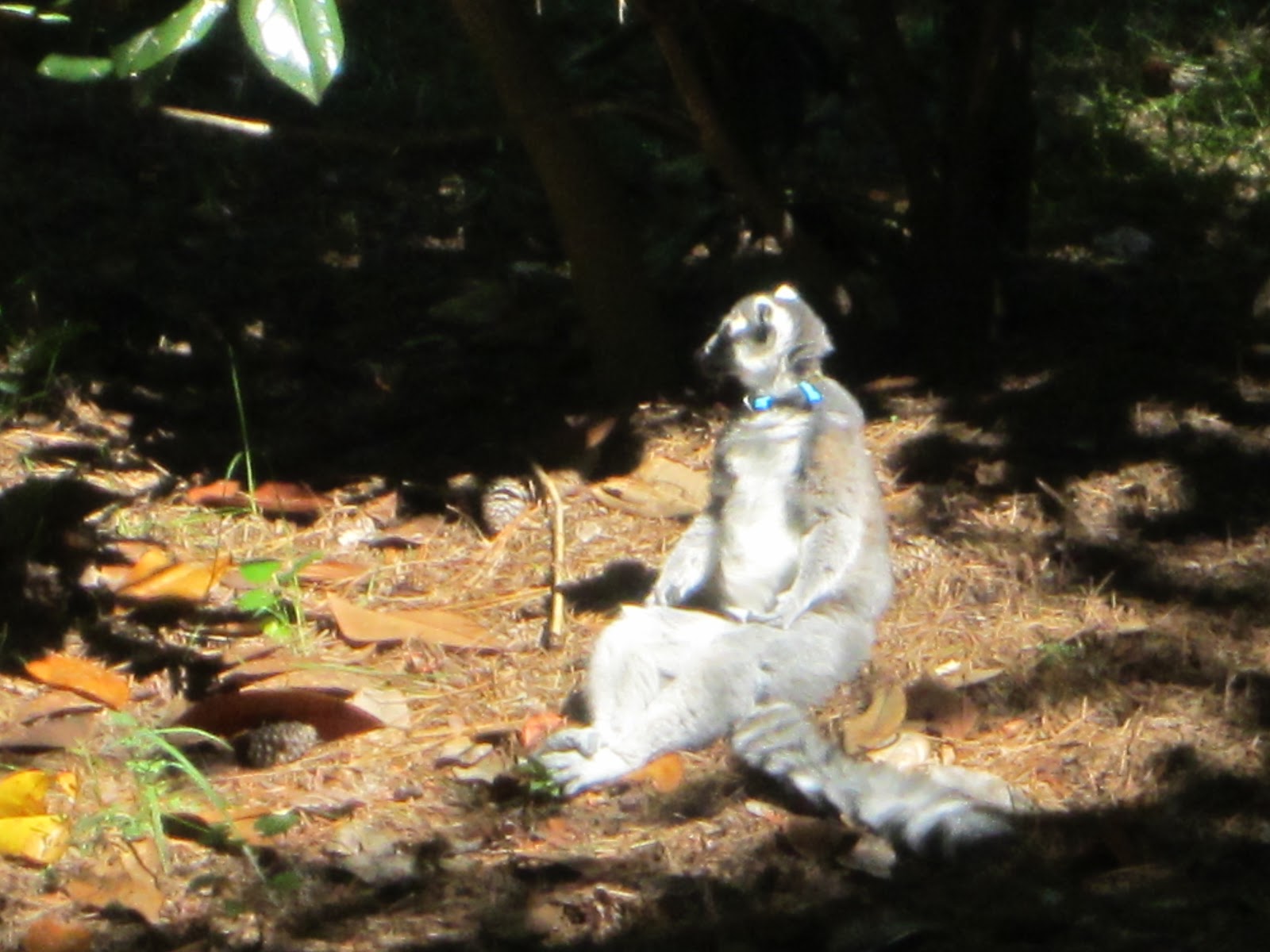
We got to see this lemur eat his lunch!
Look!  A ring-tailed Lemur!  Can you guess how he got his name?


 Time to go home!


What a great field trip!
We love the Museum of Life and Science!